Value Proposition Template: 50 Editable Slides For PowerPoint
Fifty value proposition slides in one calm blue look, from the classic canvas to a one-line promise, proof points and a summary card. Every slide carries neutral sample content that fits any business, so you only swap in your own customer, offer and figures.
This value proposition template gives you 50 ready slides to show customers, investors or your own team why your offer is the one to choose. It covers the whole value proposition canvas — customer jobs, pains and gains on one side, products and services, pain relievers and gain creators on the other — plus the one-line promise, benefits over features, proof points and the answers to for whom, what and why us. Use it as a value proposition PowerPoint template: download the PPTX, open it in PowerPoint, Keynote or Google Slides and edit every text, shape and colour.
Every slide is a different form of the same idea, so you can pick the one that suits your message: a canvas with a square and a circle, ranked bars of customer pains, a message house, a positioning statement filled in row by row, a value equation in money, customer voices with portraits or a test of your promise with real buyers. The sample story stays neutral — busy teams lose hours to slow manual work and the offer gives that time back — with round figures you replace with your own.
Your Offer In This Value Proposition Look
Describe your offer, the customers you serve, the pains you remove and the proof you have, or attach a product sheet, research notes or interview findings. ExpertSlides builds your own value proposition deck in this look in a few minutes, with your customer, your promise and your figures.
Every slide is a complete value proposition with neutral sample content — Our Offer, The Customer and the usual way, general benefits and round figures — that fits any business. Replace the customer, the offer and the figures with yours.
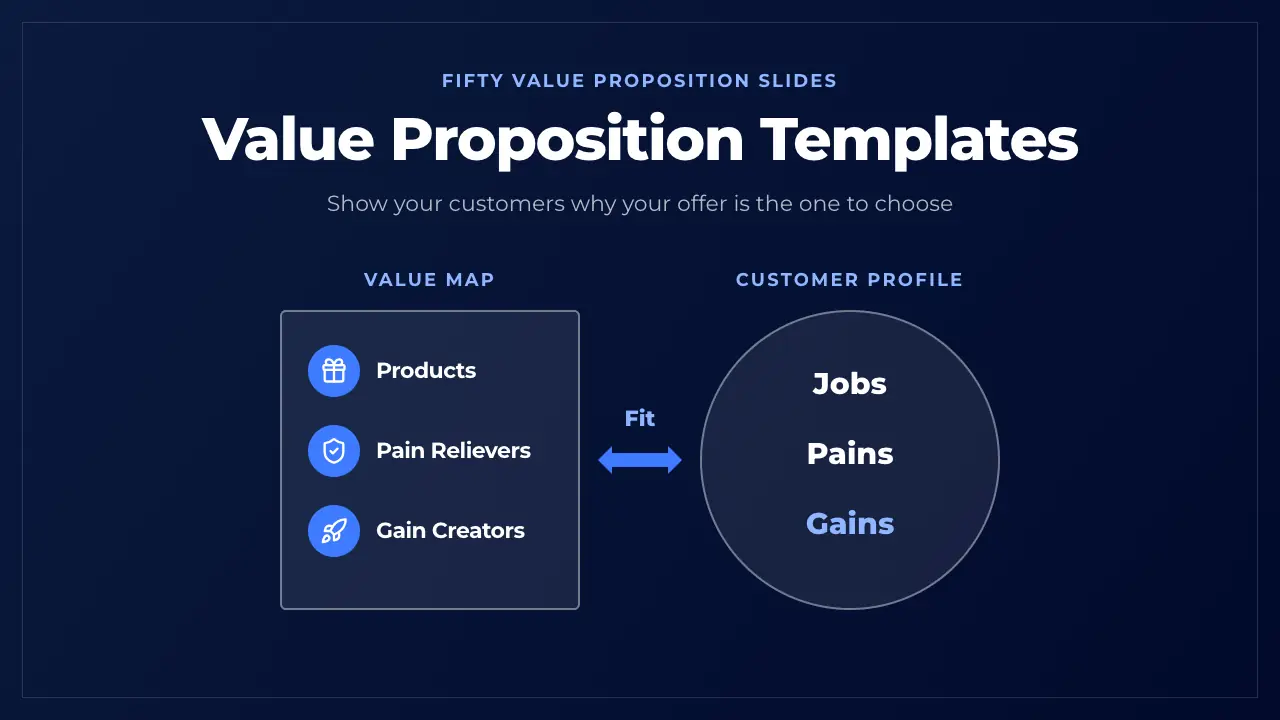
1 · Value Proposition Canvas CoverThe title slide of the pack shows the value proposition canvas in its simplest form: the value map as a square, the customer profile as a circle and the fit between them. Use it to open a talk about why customers should choose your offer. Replace the lead with your own promise.
2 · Classic Value Proposition CanvasThe full value proposition canvas on one slide: products, gain creators and pain relievers in the square; customer jobs, gains and pains in the circle. Fill each field with one short line so the fit between offer and customer is seen at a glance. Use it as the anchor slide of a strategy or product talk.
3 · One-Line Promise Beside A PhotoA tall photo beside the promise in one large line and the three answers behind it: for whom, what and why us. Use it early in a pitch to state the value proposition before any detail. Keep the promise to one sentence a customer could repeat.
4 · Customer Jobs On Three CardsThree cards for the three kinds of customer jobs: functional, social and emotional. Each card names one job in a short title and says in two lines what the customer wants to get done. Use it to start the customer profile of your value proposition.
5 · Customer Pains As Ranked BarsFive customer pains ranked as horizontal bars, each with the share of customers who name it. Use it to show which problems your value proposition must solve first. Put your own survey figures and its source in the foot line.
6 · Customer Gains As Key FiguresFour customer gains, each told by one large figure: time saved, lower cost, a fast start and cleaner data. Use it when the gains of your value proposition can be measured. Replace the figures with results from your own customers.
7 · Pains Matched To Pain RelieversEach customer pain on the left is answered by one pain reliever on the right. Use it to show that your value proposition removes every pain the customer named. Keep the pain in the customer's words and the reliever in yours.
8 · Features Turned Into BenefitsFour features of the offer on a quiet card, each turned into the benefit a customer feels on a blue card beside it. Use it to move a pitch from what the product has to what the customer gets. Write every benefit as a result, not a function.
9 · Before And After CardsTwo cards set the customer's week side by side: before the offer and after it, point by point. Use it to make the change your value proposition promises easy to see. Keep each pair of lines on the same level so they read across.
10 · Promise On A Full PhotoThe value proposition in one statement over a full photo, with three proof figures underneath. Use it as a strong opening or closing slide of a sales talk. Swap in your own photo, promise and the three figures customers trust most.
11 · For Whom, What, Why Us ColumnsThe three questions every value proposition must answer, each on its own numbered card: for whom, what and why us. Use it as a simple summary of your offer for a pitch or a strategy meeting. Keep each answer to two or three lines.
12 · Positioning Statement Filled InThe classic positioning statement laid out as six rows, each label in a pill and its sample answer beside it. Read from top to bottom it forms one sentence. Use it to agree on the wording of your value proposition with your team.
13 · Proof Points On Four CardsFour cards that back the value proposition with hard numbers: customers, rating, on-time delivery and return. Use it right after you state your promise. Replace each figure with a result you can show.
14 · Customer Profile With PortraitA round portrait stands for the buyer, with the customer profile beside it: the jobs, the pains and the gains. Use it to make the customer of your value proposition feel real. Name a role, never a real person.
15 · Levels Of Value As Rising StairsFour steps that climb from the basic value an offer must give to the highest: reliability, time saved, lower cost and full trust. Use it to show how your value proposition goes beyond the basics. Keep the lowest step for what customers simply expect.
16 · Pain To Gain In Three ArrowsThree arrows read from left to right: the customer's pain, the offer that answers it and the gain that follows. Use it to tell your value proposition as one simple story. Put a proof figure under each arrow.
17 · Value Map In Three ColumnsThe value map of the canvas laid out as three cards: the products and services, the pain relievers and the gain creators. Each card lists three short points. Use it to show what your offer holds and how it helps.
18 · Reasons To Switch Beside A PhotoThree reasons customers give for switching to the offer, each with an icon and two lines, beside a photo that fills the right side. Use it to show your value proposition through the customer's own reasons. Take the reasons from real customer interviews.
19 · Key Figure Under An ArcThe value proposition measured: one hero figure under a wide arc, and three supporting figures beside it. Use it when one number sums up your promise better than words. Keep the hero figure short so it reads from the back of the room.
20 · Offer Against The AlternativesThree cards set the customer's choices side by side: doing nothing, the usual way and our offer, each with its price and the value points it meets. The points it misses fade out. Use it to show why your value proposition beats the alternatives.
21 · Gain Creators Under A Photo BandA wide photo band across the top carries the headline on a white card, and four gain creators stand in columns beneath it. Use it to show how your offer creates each gain the customer hopes for. Keep each column to a short title and two lines.
22 · Elevator Pitch In A Speech BubbleThe value proposition as it is said aloud: a thirty-second pitch in a large speech bubble, with three keywords under it. Use it to align the whole team on the words they use with customers. Read the pitch aloud and cut it until it fits in thirty seconds.
23 · Problem-Solution Fit In Three RingsThree progress rings measure how much of the customer profile the value map covers: jobs covered, pains relieved and gains created. Use it to show the fit of your value proposition and where it still has gaps. Count from your own canvas.
24 · Value Message HouseThe message house holds the value proposition together: the core promise as the roof, three benefits as the pillars and the proof as the foundation. Use it to keep every sales and marketing message in line. Change the pillars, never the roof.
25 · Customer Quote With PortraitA customer's own words back the value proposition: a round portrait, the quote in large type, the customer's role and two proof figures. Use it after you state your promise, as the most believable proof. Ask the customer for consent before you use a real quote.
26 · Unique Selling Points As HexagonsFive unique selling points, each in a hexagon with an icon, a short title and a two-line caption. Use it to show what sets your value proposition apart from every alternative. Keep only the points a rival cannot claim as well.
27 · Feature, Advantage, Benefit ChainOne feature is carried down three steps: what it is, what it does and what the customer gets. Each step answers its own question on the right. Use it to train a team to sell the benefit of your value proposition, not the feature.
28 · Value In Three Big WordsThe value proposition boiled down to three large words, each with a short line that proves it. Use it as a memorable summary at the end of a pitch. Pick words your customers already use.
29 · Problem And Solution Beside A PhotoTwo cards state the core of the value proposition: the customer's problem and the solution the offer brings, joined by an arrow, beside a photo. Use it early in a pitch to frame the problem before you show the product. Keep both cards to two lines.
30 · Promise For Each Customer SegmentOne core value, said three ways: each customer segment gets its own promise and the figure that matters most to it. Use it when your offer serves teams of very different sizes. Keep the core promise the same and change only the words.
31 · Value Over Time As Rising ColumnsFive rising columns add up what a team saves over its first year, with the payback month marked and the return in a key-figure card beside them. Use it when the value of your offer grows with time. Replace the figures with your own customer data.
32 · Pains Relieved Beside A PhotoFour rows show each pain as it was and what the offer leaves of it, beside a calm photo that fills the left side. Use it to make the pain relievers of your value proposition concrete. Write the new state as a short, measurable line.
33 · Savings Split In A DonutA donut splits the cost saving of the offer into its sources: time, tools and errors, with the total in its centre and a legend beside it. Use it to show where the value of your proposition really comes from. The shares must add up to one hundred per cent.
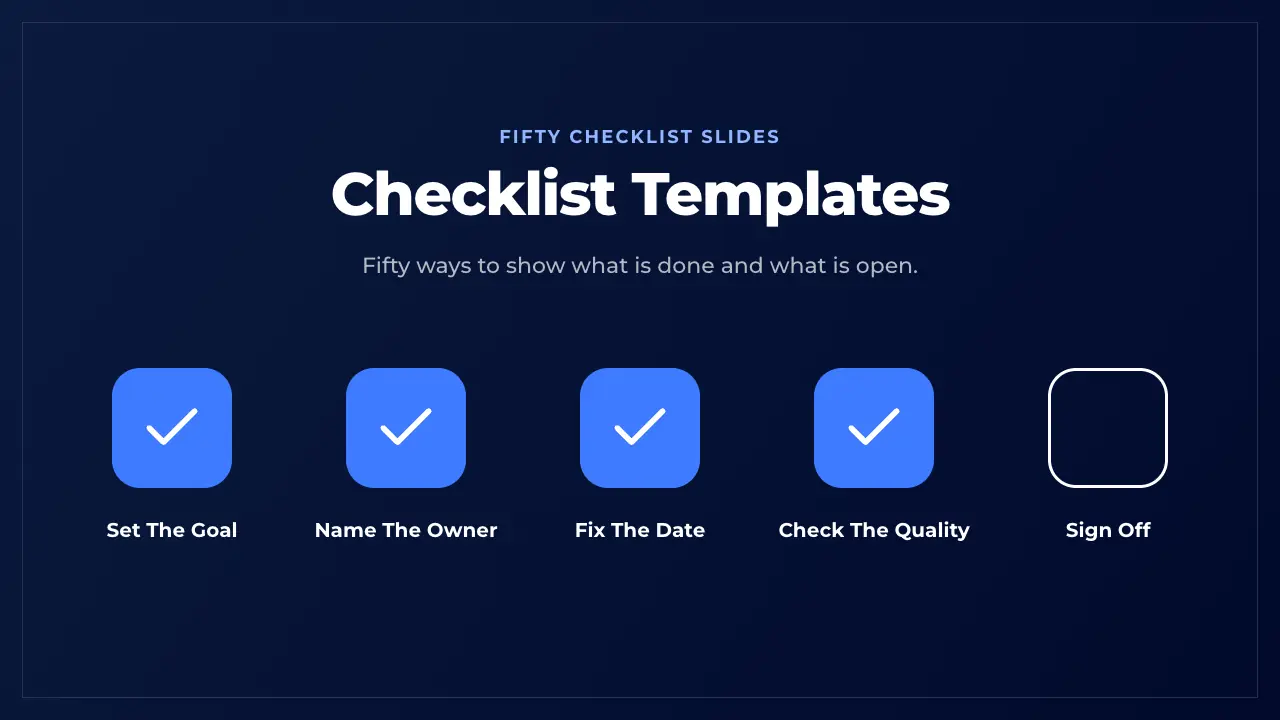
34 · Value Proposition ChecklistSix tests a strong value proposition should pass, each with a check and the question behind it. Use it in a workshop to review your own promise line by line. A promise that fails two tests needs rewriting.
35 · Value At Each Step Of The JourneyFour steps on one line, from the first contact to daily use, each with the value the customer meets there on a card beneath it. Use it to check that your value proposition holds at every point of contact. Change the steps to match how your customers buy.
36 · Big Promise Beside A PhotoThe promise of the offer in large type with a quote mark, three short proof chips under it and a photo filling the right half. Use it to state your value proposition with weight, as a single message. Keep the promise under ten words.
37 · Customer Gains Ranked By ShareFive gains ranked by how many customers call them essential, each with a large share and a thin bar. Use it to decide which gains your value proposition should lead with. Put the gain most customers want at the top.
38 · Four Reasons Around A CentreA central circle asks why us, and four cards around it answer: speed, price, trust and service. Use it to sum up the differentiators of your value proposition on one slide. Keep each reason to one short line.
39 · Value Proposition On One CardThe whole value proposition on a single card: the promise, who it is for, three benefits and the price. Use it as a one-page summary to close a pitch or to hand out. Everything on it should fit in a customer's head.
40 · Three Customer Voices With PortraitsThree customers back the value proposition in their own words, each with a round portrait, a short quote, a role and the result they saw. Use it as social proof after your promise. Name roles, never real people, unless they agreed.
41 · Customer Profile In Three ColumnsThe customer side of the canvas laid out as three columns: the jobs the customer does, the pains they meet and the gains they hope for. Use it to agree on who you are building for before you shape the offer. Three points a column are enough.
42 · Value Equation In Three BlocksThe value equation in three blocks: what the customer gains, minus what the offer costs, equals the value they keep. Use it to make the return of your value proposition plain in money. Put the basis of the sum in the line underneath.
43 · Offer Against The Market AveragePaired bars set the offer against the market average on four measures: hours saved, rating, on-time delivery and renewals. Use it to prove the claims of your value proposition with comparable figures. Name the source of the market average in your notes.
44 · Products And Services Beside A PhotoThe products and services of the offer, each with an icon, a title and one line, beside a photo of the product at work. Use it to show exactly what a customer receives. List what they get, not how it is built.
45 · Anatomy Of A Value StatementThe value proposition statement taken apart into its four parts: the customer, the problem, the offer and the result, with the full sentence underneath. Use it to teach a team how a strong statement is built. Write each part first, then join them.
46 · Three Guarantees As ShieldsThree guarantees, each a shield with its key figure, a short title and two lines underneath. Use it to take the risk out of your value proposition for a buyer who is not yet sure. Only promise what you can keep every time.
47 · Pains And Gains Around A PortraitThe customer stands at the centre in a round portrait, with the pains the offer removes on the left and the gains it brings on the right. Use it to show your value proposition from the customer's point of view. Match every pain with a gain on the same line.
48 · Functional And Emotional ValueThe slide splits the value of the offer into two halves: what it does for the customer and how it makes them feel. Use it to remind a team that people buy with both reasons. Keep three points on each side.
49 · Promise Test In Three ColumnsThree columns show how customers answered when they were shown the promise: whether they understood it, found it relevant and would buy. Use it to prove that your value proposition works before a full launch. Run the test on real buyers, not on your own team.
50 · Value Proposition Summary With PhotoThe value proposition summed up in four lines: for whom, the problem, the promise and the proof, with a call to act and a photo filling the left side. Use it as the closing slide of a pitch. Each line should be short enough to say in one breath.
Fifty Forms Of A Value Proposition In One Blue Look
A title slide that is the canvas itself, a square and a circle joined by their fit; the classic value proposition canvas in six fields; the value map and the customer profile each in three columns; customer jobs on cards, pains as ranked bars and gains as key figures; pains matched to pain relievers, features turned into benefits and a feature, advantage and benefit chain; before and after cards; the promise in one line beside a photo, on a full photo, in large type and on a single card; for whom, what and why us; a positioning statement filled in row by row and the anatomy of a value statement; proof points on cards, a customer quote and three customer voices with portraits; rising stairs of value, unique selling points as hexagons and three big words; the offer against doing nothing and the usual way, and against the market average; problem-solution fit in three rings, a message house and an elevator pitch in a speech bubble; savings in a donut, value growing month by month and a value equation in money; a checklist for a strong promise, value at every step of the journey, three guarantees as shields, functional and emotional value, a test of the promise with customers and a closing summary.
How To Use This Value Proposition Template
01
Start With The Customer
Fill in the customer profile first: the jobs your customer is trying to get done, the pains that hold them back and the gains they hope for. Slides 4, 5, 6 and 41 are built for exactly this.
02
Map Your Offer To It
Use the value map to show how your products and services relieve each pain and create each gain. The classic canvas on slide 2 puts both sides of this value proposition template next to each other.
03
Write One Clear Promise
Turn the fit into a single sentence a customer could repeat. The positioning statement on slide 12 and the anatomy on slide 45 help you build it part by part.
04
Back It With Proof
Add figures, customer voices and guarantees so the promise is easy to believe, then close with the summary on slide 50. Replace every sample figure with your own.
What A Strong Value Proposition Shows
A value proposition explains why a specific customer should choose your offer over every other option, including doing nothing. It names the customer, the problem they feel, what your offer does about it and the result they get, in words the customer would use themselves.
The value proposition canvas makes that fit visible: the customer profile on one side, your value map on the other. When every important pain has a pain reliever and every important gain has a gain creator, the promise you write on top of it is easy to defend.
Benefits, Proof And The Alternatives
Customers buy results, not features, so several slides turn features into benefits and show the change from before to after. Others put your offer against the usual way and the market average, so the difference is plain at a glance.
A promise is only as strong as its proof. Use the slides with key figures, customer quotes, guarantees and a test with real buyers to show that your value proposition holds up, and keep every claim to a figure you can show.
Value Proposition Template FAQ
What is a value proposition template?
A value proposition template is a set of ready slides that helps you explain why customers should choose your offer. This one holds 50 slides: the value proposition canvas, customer jobs, pains and gains, benefits, proof points, a positioning statement and a closing summary, all in one blue look.
Is there a value proposition PowerPoint template to download?
Yes. With a free account you can download all 50 slides as a PPTX file and open them in PowerPoint, Keynote or Google Slides. Every text, shape, icon and colour stays editable.
What is the value proposition canvas?
The canvas sets the customer profile — customer jobs, pains and gains — beside the value map — products and services, pain relievers and gain creators. The classic canvas is on slide 2, and slides 17 and 41 show each side in three columns.
Can I use it for any industry?
Yes. The sample content is neutral: the offer is simply Our Offer, the customer is named by role and the figures are round samples. Replace them with your own and the value proposition template fits a product, a service, a start-up or a large organisation.
How do I write a strong one-line promise?
Name the customer, the problem, what your offer does and the result, in that order. Slide 45 takes a value statement apart into these four parts, and slide 34 lists six tests a strong promise should pass.
Can the AI build my own value proposition deck?
Yes. Describe your offer and your customers or attach your notes, and Fill with AI builds your own deck in this look, with your customer, your promise and your figures. You can then edit every slide in the editor.
Can I change the colours and fonts?
Yes. The colour and font bar above the slides changes the whole pack at once, and a Design Kit applies your own brand colours, fonts and logo to every slide.
Try ExpertSlides AI For Free — The Ultimate AI Presentation Maker
Describe any topic or upload a document, and ExpertSlides designs and writes the whole deck — editable in the browser and as a PowerPoint file.